
Basra
Southern port city of palms, canals, and shifting tides.
About Basra
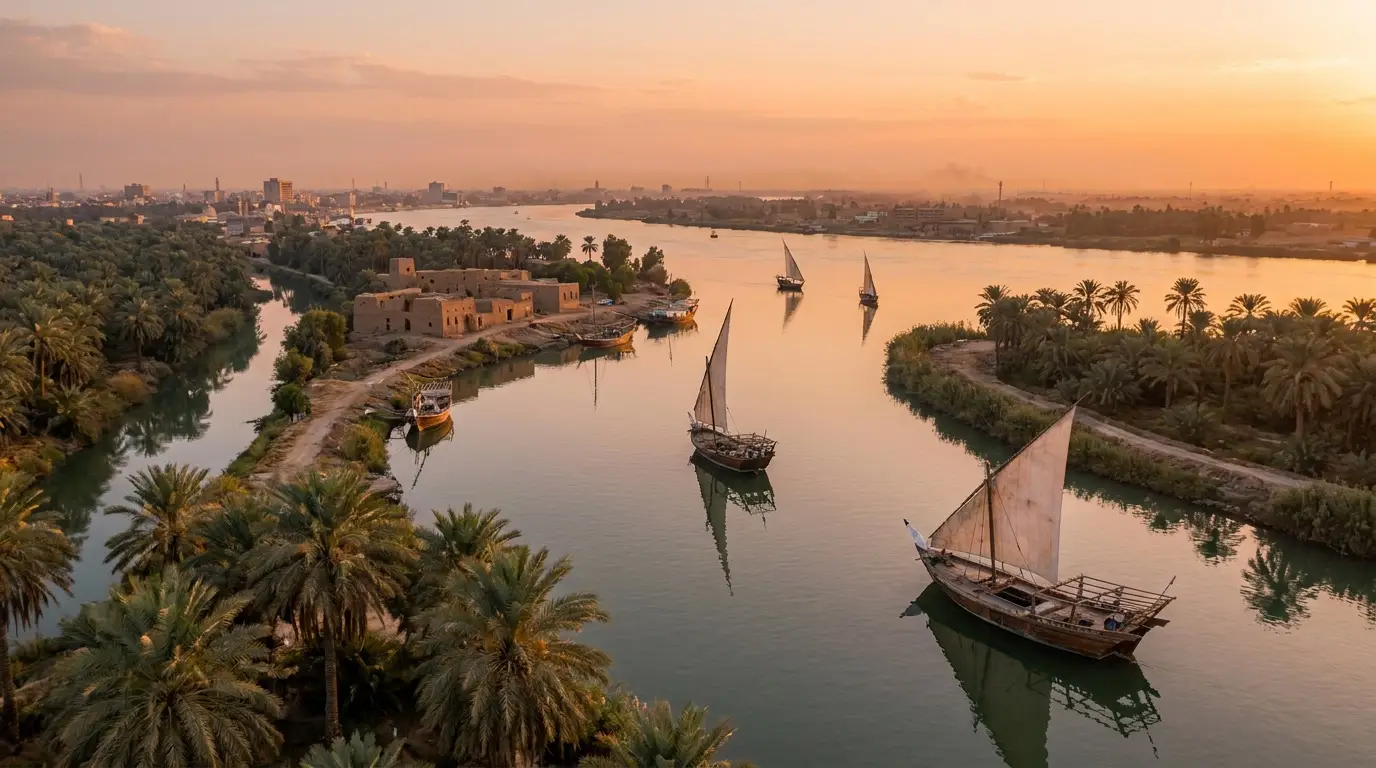
Basra lies in the far south of Iraq on the Shatt al-Arab, the wide waterway formed by the confluence of the Tigris and Euphrates as they flow toward the Gulf. With a population of around two and a half million, it is Iraq's second largest city, its principal port, and the center of the country's oil industry, which has shaped its modern economy and skyline. Basra has long been known as the City of Date Palms, and although decades of conflict and salinization have reduced the groves, the southern outskirts and riverbanks still glow with palm canopies. Older neighborhoods such as Al-Ashar and Old Basra retain elegant if weathered shanasheel houses with carved wooden balconies, narrow lanes, and traces of the canals that once led the city to be called the Venice of the East. Travelers come for the Corniche along the Shatt al-Arab, the lively souqs, the maritime atmosphere of the port, and excursions to the marshes upstream. Basra is also a gateway for pilgrims and traders arriving overland from Kuwait and by sea from across the Gulf.
Basra through history
Basra was founded in 636 CE as a garrison town by the early Islamic caliphate during the conquest of the Sasanian Empire, and it quickly developed into one of the great cultural centers of the early Arab-Islamic world. Its scholars contributed foundational work to Arabic grammar, theology, and prose, and the city is associated with figures such as al-Hasan al-Basri, al-Jahiz, and the rationalist Mu'tazila school. Over the following centuries Basra rose and fell with regional powers, was sacked, rebuilt, and contested by Abbasids, Buyids, Ottomans, Safavids, and Portuguese sea powers. From the nineteenth century onward it became a key node in Gulf trade, then a battlefield during the British Mesopotamia campaign of the First World War, and later a frontline city during the eight-year Iran-Iraq War of the 1980s, which left deep marks on its eastern districts.
- 2,600,000
- 636
When to visit
Basra is best visited between November and March, when temperatures are pleasant during the day, the humidity has eased, and evenings on the Corniche are at their most enjoyable. Spring is warm but still comfortable, and the date palms and citrus orchards are in flower. Summers from May through September are intensely hot and notoriously humid, with daytime highs often above 48 degrees Celsius, and most outdoor activity shifts to the late evening. The Basra International Festival and assorted poetry and book events draw visitors during the cooler months.
Top places in Basra

What to eat in Basra
Basra cuisine reflects its maritime setting and Gulf ties. Grilled river prawns and fish from the Shatt al-Arab, masgouf carp, and the rice and seafood dish makboos are local favorites. Date-based desserts and date syrup, known as dibis, accompany breakfasts of bread, cheese, and clotted cream. The city is known for its sweets, particularly muhalabia, zalabia, and the dense almond-and-date pastries popular during religious holidays. Tea houses near the bazaar serve cardamom-laced black tea throughout the day.
Getting there
Basra International Airport (BSR) lies west of the city and is served by carriers from the Gulf, Turkey, and Europe, with frequent connections to Baghdad and other Iraqi cities. Overland, shared taxis and private cars link Basra with Baghdad in roughly six to seven hours, Najaf and Karbala in four to five, and Amarah in around two and a half. The land border with Kuwait at Safwan is open for commercial traffic and for travelers with appropriate visas, and overnight buses cross to Kuwait City.
Getting around
The city is spread out, and most travelers rely on taxis and ride-hailing apps such as Careem, which work well in the central districts. The Corniche along the Shatt al-Arab is best explored on foot in the cooler hours, and the Old Basra district rewards a slow walking visit with a local guide who can point out the surviving shanasheel houses and former synagogues, churches, and Jewish quarter landmarks. Small wooden launches still ferry passengers across parts of the river, and boat trips upstream from the Corniche offer a striking perspective on the city and the marshes that begin not far to the north.
Money & payments
Basra has an oil-economy overlay that makes USD especially common: oilfield contractors, hotel chains catering to engineers, and upscale restaurants quote and accept dollars without hesitation. Card acceptance is reasonable at international-branded hotels (Mnawi Pasha, Grand Millennium) but limited elsewhere. ATMs are concentrated in the corniche and Al-Ashar areas; foreign-card success is hit or miss. Licensed moneychangers near Al-Ashar souk and along the main commercial streets give better rates than hotels. Carry cash for taxis, the corniche cafes, and the Shatt al-Arab boat trips. Summer heat and frequent power cuts make ATM availability even less predictable.
Safety
Basra has been broadly stable in recent years, although the city has seen periodic protests over services, employment, and water quality that occasionally affect central squares and roads. Travel between Basra and the rest of southern Iraq is routine, and visitors generally move around without incident. Heat and dehydration are the most pressing day-to-day risks for much of the year, and standard precautions around demonstrations and unfamiliar neighborhoods are advisable.